

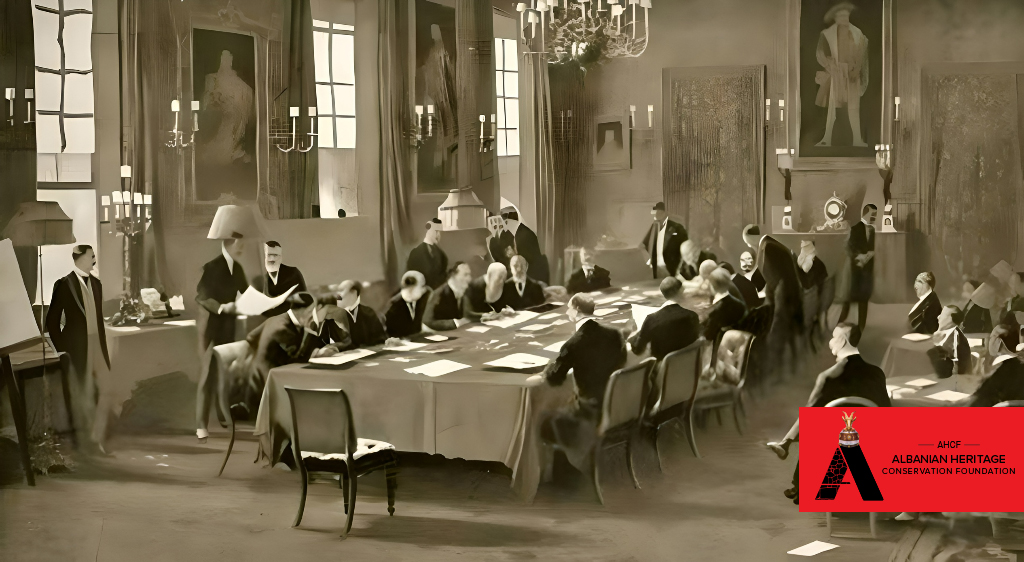
The Conference of Ambassadors in London recognized Albania as a “sovereign principality,” excluding any dependency on the Ottoman Empire. The Conference of Ambassadors in London was organized by the six Great Powers of the time: England, Austria-Hungary, Germany, Italy, France, and Russia. It was created to address the issues that arose after Turkey’s defeat in the war with the Balkan allies. The powers were represented there through their ambassadors accredited in the British capital. The British Foreign Minister Edward Grey was elected as the chairman of the Conference. The Albanian issue was at the center of attention of the Conference of Ambassadors. At its first meeting, it decided that Albania should be declared an “autonomous” state under the sovereignty of the Sultan. However, with the final decision of July 29, 1913, Albania was recognized as a “sovereign principality.” The Conference of Ambassadors did not recognize the internal organization of Albania to the Provisional Government of Vlora (1912), but left it in the hands of the Great Powers. The task of creating various branches of the administration of the new state was entrusted to an International Commission of Control. Even the organization of the public order forces (gendarmes) was entrusted to foreign officers. Regarding the borders, the Conference of Ambassadors committed a great injustice to the Albanian nation. The participating powers did not respect the fundamental rights and interests of the new Albanian state. Within its borders, only half of the Albanian lands were included, an area of about 28,000 km² and less than half of the population with Albanian nationality, around 800,000 people. More than half of the Albanians remained outside the borders of the Albanian state. Most of them fell under Serbia, while the rest fell under Montenegro and Greece. A small Greek minority was left within the borders of Albania (in the area of Gjirokastra). (Pictured: Ambassadors’ Conference in London.)
Text: Albanian encyclopedic dictionary – Vol. 2 , Academy of Sciences of Albania, “Kristalina-KH”, Tirana, 2008, page 1242.
Photo: © Institute of Historical Studies “Lumo Skëndo”, Tirana.
Graphic processing: AHCF