

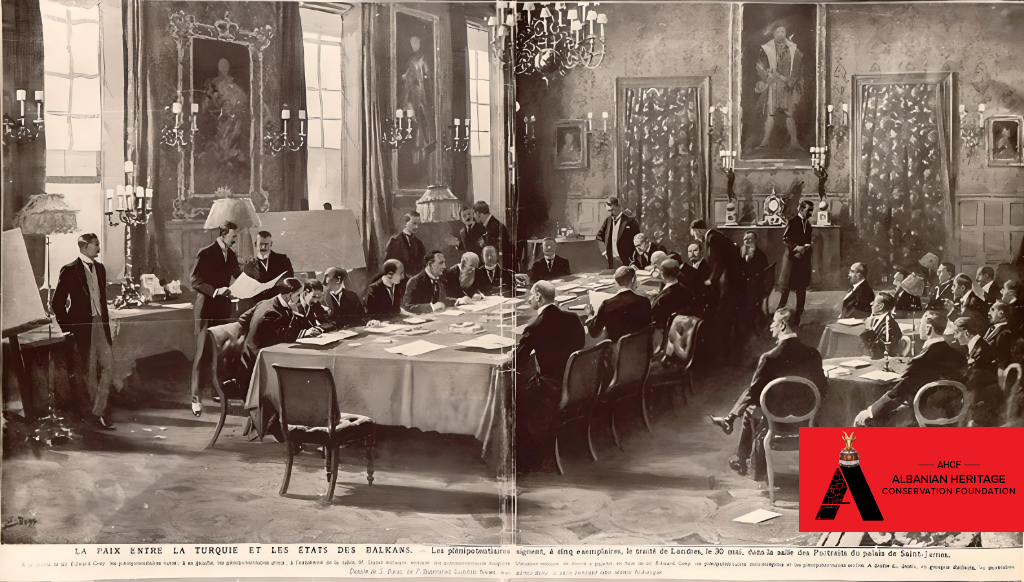
Under the permanent chairmanship of the British Foreign Minister, the Ambassadorial Conference began in London, the sixth organ of the Great Powers of the time: England, Austria-Hungary, Germany, Italy, France, and Russia. From its first day of work, on December 17th, the conference took up the Albanian issue for consideration. The issue was discussed in its two main aspects: the political future of Albania and the delineation of borders. For the first point, the ambassadors decided that an autonomous Albania should be “created” “under the sovereignty or suzerainty of the Sultan”, so that it would be placed “under the guarantee and exclusive control of the Six Powers” and declared “inalienable”. This decision of the conference, although it thwarted the chauvinistic plans of neighboring governments for the complete partition of Albania, was a step back compared to the decisions of the Vlora Assembly and, in general, contradicted the developments in Albania since November and beyond. While the Vlora Assembly had declared Albania’s separation from Turkey and its complete independence, the London Conference decided to leave it still within the framework of the Empire, recognizing only its right to internal autonomy. Furthermore, the London Conference decided not to heed anything that could be done within Albania for the organization of the Albanian state with the country’s own living forces. Thus, it tasked Austria-Hungary and Italy, as a concession to their “special interests” in Albania, to draft and present a more detailed project for the organization of the autonomous Albanian state. Regarding borders, in its first session, the conference only made general decisions. It decided in principle that autonomous Albania should be bordered in the north by Montenegro and in the south by Greece. This had its advantage because, by designating Montenegro as the northern neighbor, it closed off Serbia’s territorial extension route towards the Adriatic. However, Serbia’s old demand for an “exit to the Adriatic” was not entirely rejected. The ambassadors acknowledged Serbia’s right to have a trade outlet to the sea through an Albanian port “free and inalienable”. This port would be used via an international railway under European control and under the supervision of a special international force with free passage for all types of goods, including war materials. This was the first limitation imposed on the territorial sovereignty of the new Albanian state. (In the photograph: Moment from the Conference of Ambassadors, 1913.)
Text: The history of the Albanian people – Vol. III , Academy of Sciences of Albania, “Toena”, Tirana, 2007, page 20.
Photo: © https://en.wikipedia.org/wiki/London_Conference_of_1912%E2%80%931913
Graphic processing: AHCF