

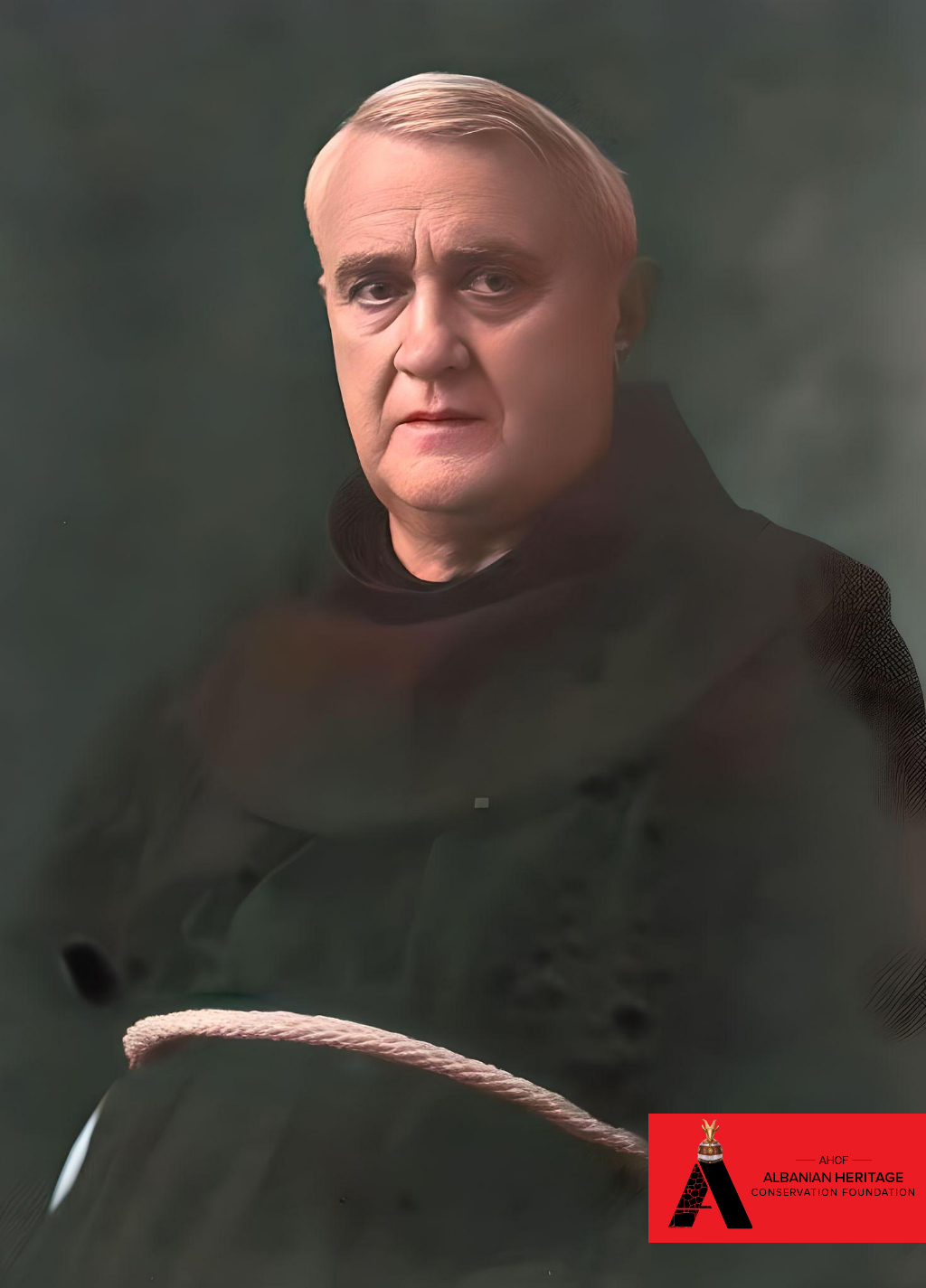
In Shkodra, Gjergj Fishta passed away, a poet, high-ranking cleric, aesthete, politician, polemicist, and playwright. He was born in Fishtë e Zadrima in 1871. He was recognized and accepted during his lifetime as a national poet with the epic poem “Lahuta e Malcis” (“The Highland Lute”). His influence and contribution were significant beyond literature, and besides being a writer, Fishta was known as a cleric, politician, publicist, and founder of cultural and educational media institutions. He began his elementary education at the Franciscan Seminary in Shkodra and continued it at the Troshan Seminary. He completed his higher studies in philosophy and theology in Bosnia, at the Sutjeska and Livno assemblies. Here, he came into contact with the works of Slavic poets such as Grga Martić, Petar Petrović Njegoš, and especially his favorite author Ivan Mažuranić, whose influence seems to have been significant during this period, alongside authors from Greek and Latin antiquity. He was ordained a priest in 1894, as a cleric of the Franciscan Order, and thereafter dedicated himself to intensive clerical, cultural, and political activities. He was one of the activists of the cultural society “Bashkimi” (“Unity”) and its representative at the Congress of Manastir (1908), where he was elected co-chairman of the Albanian Language Alphabet Commission. In 1913, he founded the magazine “Hylli i Dritës” (“The star of the light”) and was its first editor-in-chief. He served as the general secretary of the Albanian delegation at the Paris Peace Conference (1919). In 1921, he was elected as a deputy in the Albanian parliament and its vice-chairman. In the same year, he founded the Franciscan high school “Illyricum” in Shkodra. From 1935 to 1938, he was appointed provincial of the Franciscan Order, and a year later, he was elected a member of the Academy of Sciences and Arts of Italy. In addition to being an epic poet through “The Highland Lute”, Fishta also successfully created works in lyric and dramatic genres. He only practiced prose through journalism. Fishta gained fame as a national poet or “Albanian Homer” through the epic poem “The Highland Lute”. The complete work with its 30 songs was published in 1937, meaning it took the poet 32 years to complete his masterpiece, indicating that he valued this work above all his other works. As a lyricist, Fishta achieved recognition through poems collected in the publications “Mrizi i Zanave” and “Vallja e Parrizit“. The first volume is more in line with the lyricism and patriotic emotion of the Renaissance; the second volume follows the path of metaphysical religious literature. Dominant here is engaged poetry, sometimes serving ethnicity, sometimes serving faith. However, in the poem “Nji lule vjeshtet” (“An Autumn Flower”) Fishta appears as a pure lyricist of intimacy, of human sorrow, of longing for the loss of a loved one, as a metaphysician of life and death, of love or eros precisely in the Platonic sense of the term. This poem is among the best lyric poems, not only of Fishta, but of all Albanian lyricism. He passed away in 1940 and was buried with great honors in the city of Shkodra. After the establishment of the communist regime, his work was declared reactionary and banned from circulation. In 1967, Fishta’s grave was desecrated by the communist regime, and his remains were thrown into the Drin River. His work continued to reach readers in Kosovo and the diaspora. For the first time, his complete works were published in Prishtina in 1996-1997. (In the photo: Gjergj Fishta)
Text: The encyclopedic dictionary of Kosovo – Vol. I , Academy of Sciences and Arts of Kosovo, Prishtina, 2018, page 450–451.
Photo: © https://en.wikipedia.org/wiki/Gjergj_Fishta
Graphic processing: AHCF