
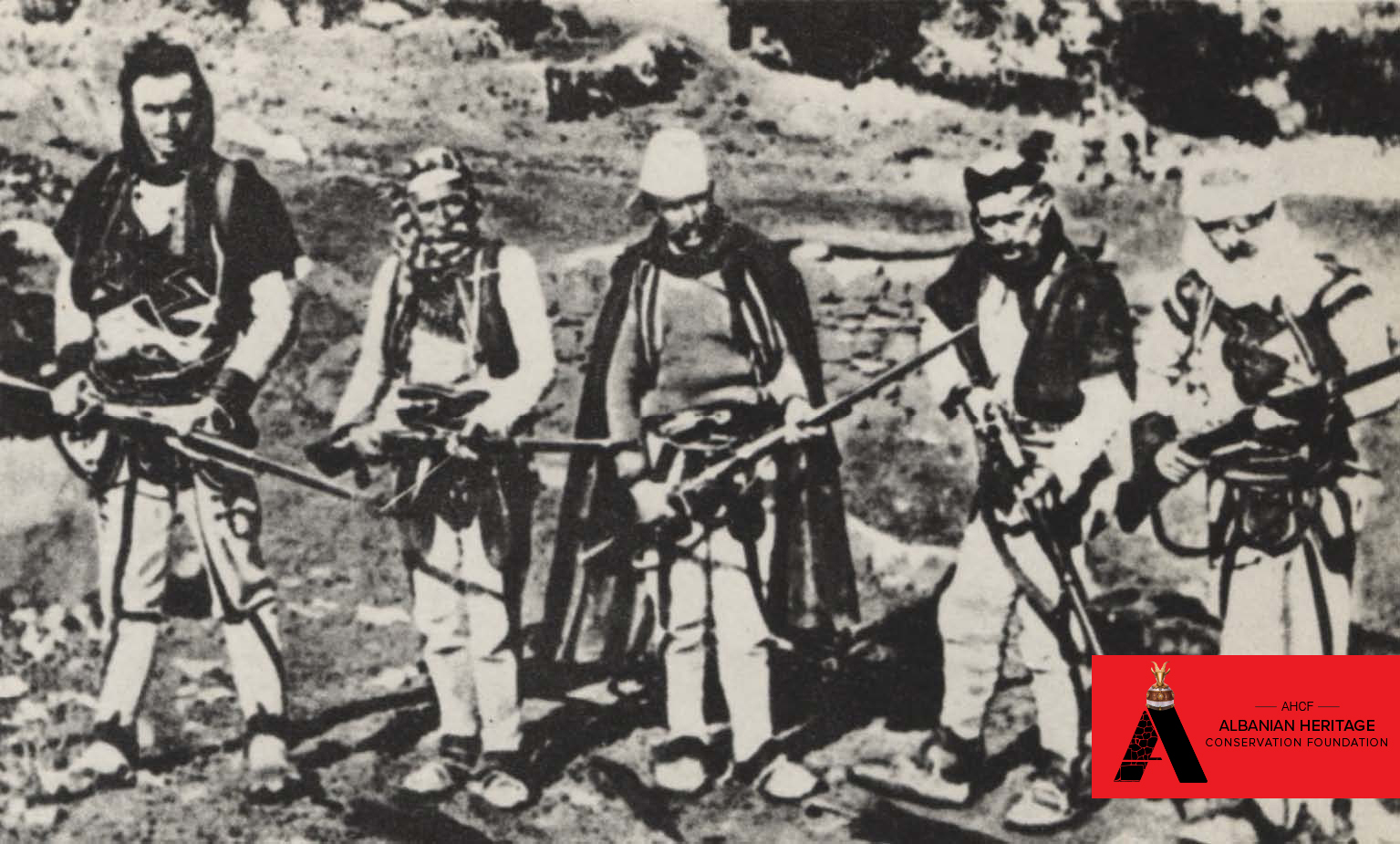
The “Agreement of Podgorica” was signed, marking the official accord between Albanians and representatives of the Ottoman government at the end of the Upper Shkodra Highlands uprising in 1911. The mountain insurgents, led by Ded Gjo Luli, resisted the military expedition of Shefqet Turgu Pasha for four months, demanding that the Turkish government implement the Albanian autonomy program set forth in the Greek Memorandum. Attempts by the Ottoman administration to subdue them through successive partial concessions and amnesties proved unsuccessful. However, placed in a very difficult situation and under pressure from the Montenegrin government, the Northern insurgents eventually agreed to negotiate with the Young Turk authorities, but only on the basis of their demands and with the insistence that the rights promised to the highlanders be recognized throughout all Albanian territories. Although the anti-Ottoman armed movement also spread to the south of Albania, the Upper Shkodra Highlands uprising of 1911 could not transform into a general uprising that would compel the Young Turks to accept not only the solution to the issues of the Northern Highlanders but also the Albanian question as a whole. Taking advantage of the weaknesses of the Albanian movement, the Ottoman authorities managed to reach agreements not only with the highlanders but also with the Southern Albanians. The Young Turk counter-proposals announced in Podgorica on July 30, 1911, were far from the autonomy proposed by the Albanian insurgents and extended only to the area affected by the Upper Shkodra Highlands uprising. The Young Turk government announced a full amnesty for all participants in the uprising. Military service would be performed within the province of Shkodra for one year, with additional service required in Istanbul. The tax on livestock would be determined considering the economic conditions of the population, and in general, taxes would only be collected when Albanians were able to pay. Weapons could be carried only with special permits. Furthermore, two primary schools would be established in the highlands with state funding, where the Albanian language would be taught, along with the construction of roads, bridges, and other facilities. Based on these proposals from the Turkish government, the agreement between the highlanders and representatives of the Istanbul government was signed on August 2, 1911, in the representation of the Ottoman Empire in Podgorica. The Agreement of Podgorica marked a step forward in the efforts of Albanians to secure their national rights; however, it was merely a truce, which ended with the onset of the general uprising in 1912. (In the photo: Ded Gjo Luli with his fellow insurgents)
Text: Albanian encyclopedic dictionary – Vol. 2 , Academy of Sciences of Albania, “Kristalina-KH”, Tirana, 2008, page 1643-1644.
Photo: © https://albemigrant2011.wordpress.com/malsia-e-mbishkodres-kryengritje/
Graphic processing: AHCF