

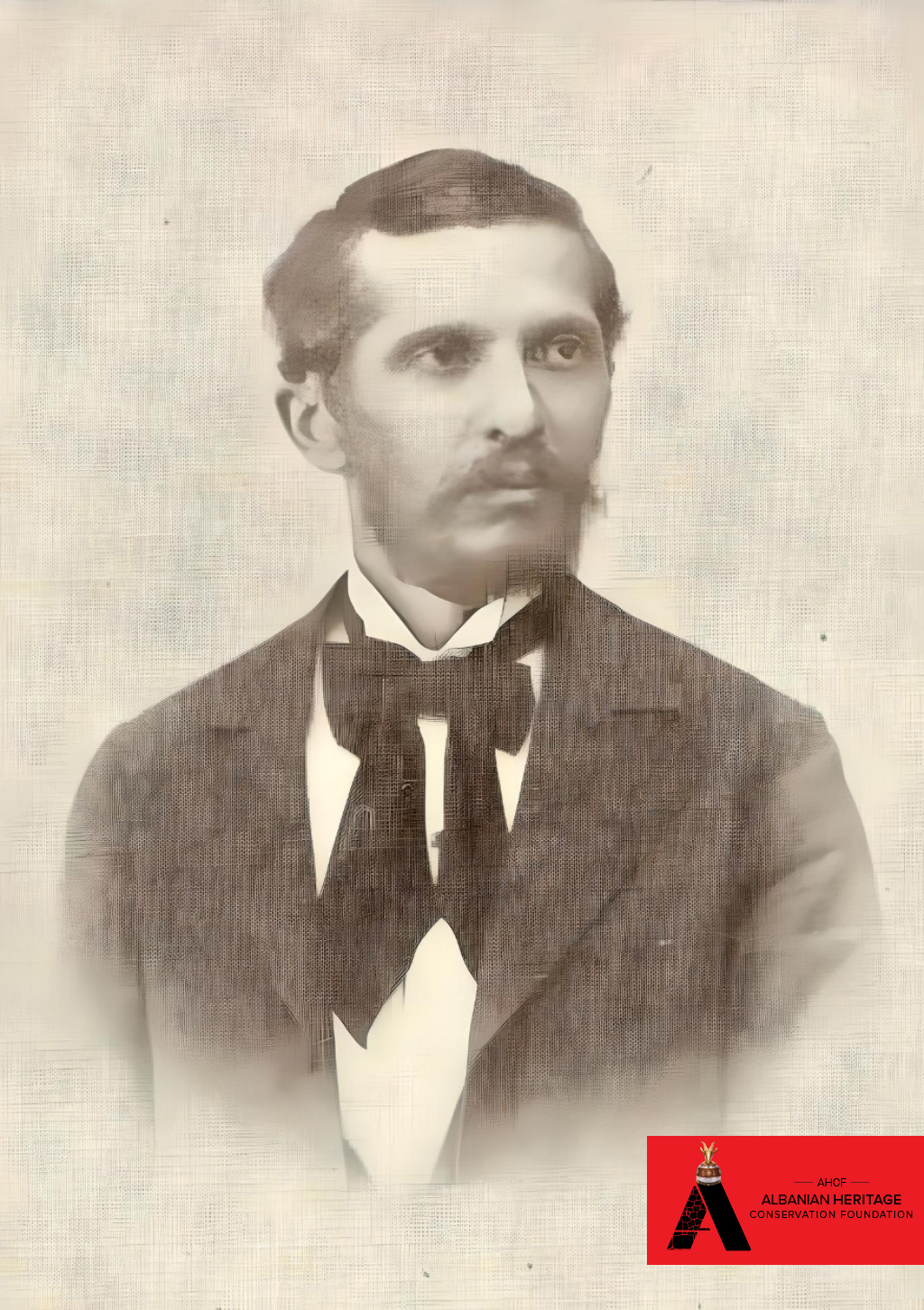
Naim Frashëri (1846–1900), poet, enlightment thinker, activist of national education and culture of the National Renaissance, was born in Frashër in Dangëllia. He received his first lessons in his hometown, where he began to learn Persian at the Bektashi tekke. In 1865, his family moved to Ioannina, where he and his brother Sami attended the “Zosimea” gymnasium, which they completed in 1869. After his studies, he worked briefly in Istanbul as a junior clerk in the printing office (1870), but tuberculosis struck him, and he returned to his hometown for a better climate. Naim Frashëri participated in the events of the League of Prizren; he stood by his elder brother, Abdyl, at the assembly of the Southern branches of the League of Prizren in Frashër (1878). The strong influence of these events and the patriotic and cultural activities of the Society of Stamboll, led by Sami, fully engaged him in the national movement. He devoted himself to the national awakening by cultivating the Albanian language and literature and promoting Albanian education by providing it with textbooks in the native language. In 1882, he settled permanently in Istanbul, where he initially worked as a member and later chairman of the Publishing Committee at the Ministry of Education. He was one of the main founders of the magazine “Drita” (later “Dituria”), where he published his first works, poems, didactic prose, and verses for primary schools, as well as translations. With his strong patriotic and cultural dedication and activity, Naim Frashëri became a central figure of the National Renaissance. In less than twenty years, he produced a wide-ranging body of work in Albanian and other languages, including poems, lyric collections, artistic prose, verses, and texts for schools and translations. In his first poem in Albanian titled “Shqipëria” (1880), he proclaimed patriotic poetic ideas, which became the leitmotif of his work and of the entire poetry of the Renaissance. His most distinguished poetic works are the lyrical poem “Bagëti e bujqësija” (Livestock and Agriculture) (1886), the collection of patriotic and philosophical lyrics “Luletë e verësë” (Summer Flowers) (1890), and the epic poems “Istori e Skënderbeut” (Skanderbeg History)(1898). For schools, he published the collection of verses “Vjersha për mësonjëtoret të para” (Poems for primary school) ( (1886), the book in two parts with singing pieces for classrooms “E këndimit çunavet këndonjëtoreja” (1886), the didactic texts “Istori e përgjithshme për mësonjëtoret të para” (General history for the primary schools) (1886), “Istori e Shqipërisë” (1899). Naim Frashëri cultivated Albanian in the poetic and didactic sphere, displaying a particular creative linguistic force. His work played a fundamental role in the development of the new literary Albanian, which he wrote purely, with a rich vocabulary and especially phraseological, mainly based on living language and the branch of popular speech, enriching it especially with words from the didactic and cultural spheres, which remained timely, giving the Albanian language the face of the modern language of modern Albanian culture. Naim Frashëri’s work established a sustainable tradition and had a great influence, not only on his contemporaneous writers but also later. It has been widely published and continues to be reprinted, included in school texts, and has become the subject of scholarly studies. The name of Naim Frashëri is carried by various schools and institutions in the Albanian world, as well as the high order given to distinguished individuals in Albania in culture, art, and science. (In the photo: Naim Frashëri)
Text: Albanian encyclopedic dictionary – Vol. 1 , Academy of Sciences of Albania, “Kristalina-KH”, Tirana, 2008, page 726-728.
Photo: © https://sq.wikipedia.org/wiki/Naim_Frash%C3%ABri
Graphic processing: AHCF