

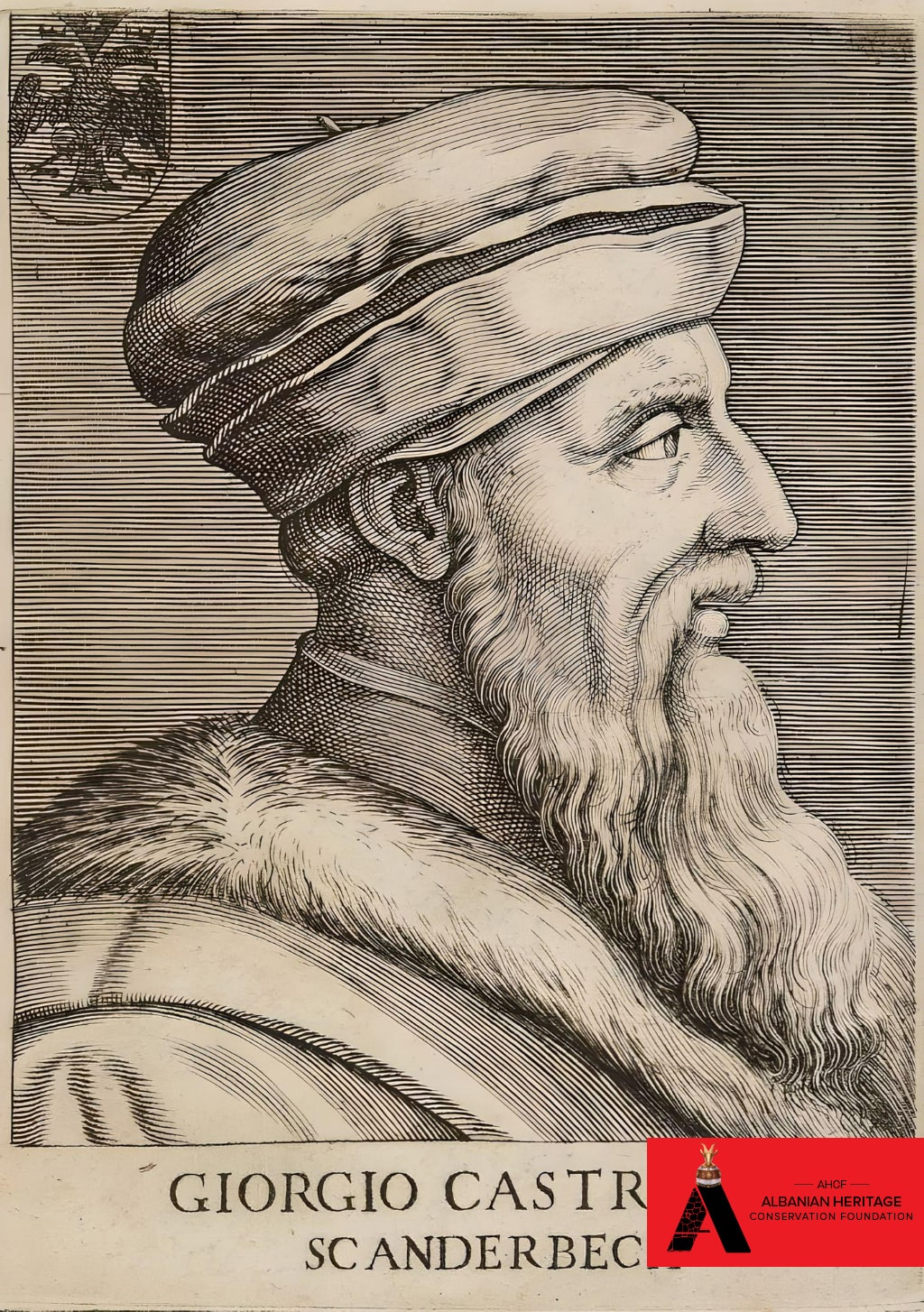
The Albanian nation commemorates its legendary Hero, Gjergj Kastrioti Skanderbeg, a great strategist and statesman, who led the fight for freedom and independence against the Ottoman occupation, for the political-state union of the Albanian people. He personifies not only the most important figure of the Albanian people, but also an entire era of national history. The figure of our national hero is associated with the century-long struggle against the Ottoman occupation. The struggle of the Albanians led by their leader marks a decisive turning point in the political organization of the country, as well as in the strengthening of national unity. After liberating Kruja, on November 28, 1443, he raised the flag of the Kastriots and on March 2, 1444, in the Cathedral of Saint Kolli in the city of Lezha, Skanderbeg held the First National Assembly. As the leader of the Assembly, he emphasized the necessity and importance of the unification of Albanians. It was the assembly where the foundations of national unity were laid. The massive mobilization of Albanian forces, which began in Dibra, expanded throughout the country, and, within a short time, turned into a general uprising. Within the first months, several principalities and most of the Albanian lands were liberated. The Albanian forces, led by Skanderbeg, won a series of battles against the Ottoman armies, such as in the fields of Pollog, Dibra, Ohrid and Domosdova, the gorges and valleys of Shkumbin, the fields of Uji i Bardhë, of Livad near Ohrid, Vajkal etc. After years of struggle and resistance to the Ottoman occupation, leading the Albanians’ struggle for freedom, Gjergj Kastrioti Skanderbeg died in Lezhë. His figure and the war he led became a source of inspiration during the wars for the freedom and independence of the homeland, especially during the National Renaissance. (In the photo: Portrait of Gjergj Kastrioti Skanderbeg, British Museum, London.)
Text: Albanian encyclopedic dictionary – Vol. 3, Academy of Sciences of Albania, “Kristalina-KH”, Tirana, 2009, page 2348-2354.
Photo: © https://www.britishmuseum.org/collection/object/P_1866-1208-754
Graphic processing: AHCF